30 July 2026
Across 565 participants in five countries, objective cough monitoring showed that TB cough falls within the first days of treatment, distinct from other respiratory disease, establishing continuous cough frequency as a fast, decentralized readout of TB treatment response.
Partner: University of California, San Francisco (UCSF), Sophie Huddart, PhD, MSc
Study type: Multi-country, decentralized, prospective continuous cough monitoring, nested in a TB diagnostics trial (R2D2 TB Network)
Therapeutic area: Tuberculosis / respiratory infectious disease
Setting: Five countries — Uganda, South Africa, Vietnam, the Philippines, India
Year: Monitoring completed 2022; published 2023 (Int J Tuberc Lung Dis)
Publication: Peer-reviewed, published in the International Journal of Tuberculosis and Lung Disease
Key outcome:
Across 565 participants in five countries, objective cough monitoring showed that TB cough falls within the first days of treatment, distinct from other respiratory disease, establishing continuous cough frequency as a fast, decentralized readout of TB treatment response.
Cough is the entry point to almost every TB workup, yet it is one of the least reliable signals in respiratory medicine. Patients routinely misjudge how much they cough, and a substantial share of people with confirmed pulmonary TB report no cough at all. The tools used to confirm treatment response are objective but slow: sputum culture, the reference standard, can take six to eight weeks to return a result.
For a research team working across high-burden, low-resource settings, that left a gap. There was no lean, objective, decentralized way to measure whether and how fast a patient's cough was actually changing after treatment began, and no way to compare that trajectory between people who turned out to have TB and people who did not.
The UCSF team set out to test whether passive, continuous cough monitoring could fill that gap, in the real-world conditions where TB is actually diagnosed and treated rather than in a controlled clinic.
Hyfe deployed its Research application on study-issued smartphones across five countries, nested inside the R2D2 TB Network's ongoing diagnostics trial. Adults presenting as TB suspects, with new or worsening cough of at least two weeks, were enrolled and monitored continuously for 14 days from the point of enrollment, spanning the initiation of TB treatment.
The application captured coughs passively as participants went about daily life, using an on-device two-stage algorithm that detects explosive sounds and classifies them as cough. Only cough timestamps left the device; no audio was transmitted, preserving participant privacy by design. TB status was established independently against a microbiological reference standard (sputum Xpert MTB/RIF Ultra and culture), allowing the team to compare cough trajectories between participants with microbiologically confirmed TB, clinically diagnosed TB, and other respiratory disease.
What made the deployment distinctive was that it worked under these conditions: a fully decentralized, multi-country, continuous-monitoring setup running in exactly the settings where TB care happens, generating objective, timestamped cough data at population scale.
All figures from Huddart et al., Int J Tuberc Lung Dis 2023 (n=565, as of 15 Aug 2022 datacut).
| Metric | Result |
|---|---|
| Participants monitored (with reference-standard result) | 565 |
| Countries | 5 |
| Continuous monitoring period | 14 days |
| Microbiologically confirmed TB | 144 (25.5%) |
| Clinically diagnosed TB | 48 (8.5%) |
| Other respiratory disease | 373 (66.0%) |
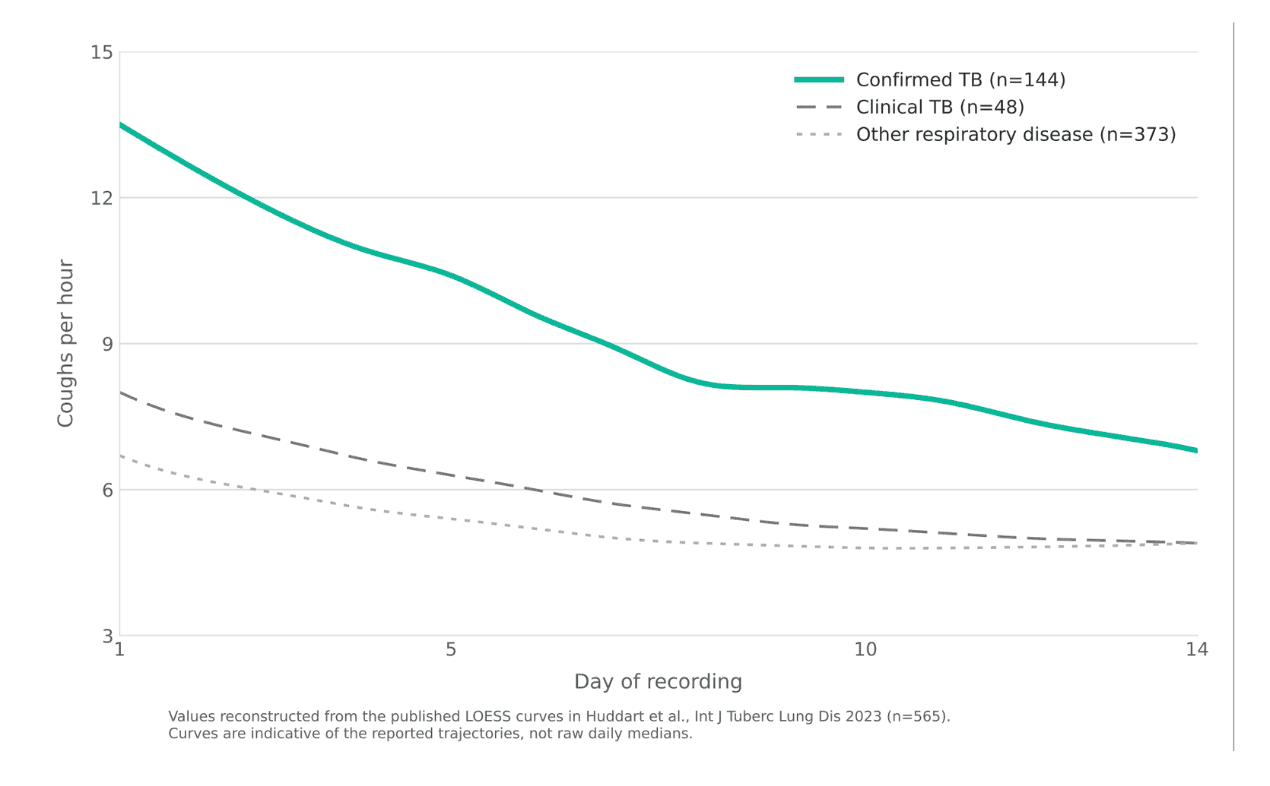
| Day 1 median cough/hour — confirmed TB | 8.0 |
| Day 1 median cough/hour — other respiratory disease | 5.0 |
| Day 1 difference (confirmed TB vs other respiratory disease) | p < 0.001 |
| Overall median cough/hour, Day 1 → Day 14 | 5.0 → 3.5 |
| Decline by Day 14 (all groups) | Significant (p < 0.001) |
Headline finding: Participants with microbiologically confirmed TB began with markedly higher cough frequency and improved more rapidly once treatment started, following a trajectory distinct from other respiratory disease and converging with it by Day 14.
The TB field is often slow to benefit from technological advances, but mobile health tools, like continuous cough monitoring, are an exciting avenue to make TB care more responsive and less burdensome on people with TB.
Study Investigator
UCSF
For sponsors and CROs developing TB and respiratory therapies, this study is early, peer-reviewed evidence that objective cough frequency could serve as a fast, decentralized signal of treatment response, potentially moving within days where sputum culture takes weeks. Proven here on Hyfe's research application across five countries, that same capability is now delivered on the wrist-worn CoughMonitor Suite platform, and is being carried forward in Hyfe's ongoing work with UCSF on cough and activity biomarkers as predictors of post-TB lung health.